
sound archive / field recording
I offer workshops dedicated to listening, field recording and tuning in to environmental sound for beginner and advanced levels. I also give lectures or seminars based on my research interests: birdsong, biosemiotics and mimicry ; chronobiology and sonic markers in nature-culture environments ; rhythmanalysis and urban soundscapes ; slow recording and time manipulations, etc.
I have taught in DIY spaces like Refuge Worldwide (Berlin, DE), Couvent Levat (Marseille, FR) as well as institutions like HKB Bern (CH), Hasso-Plattner Institute Potsdam (DE), Universität der Künste Berlin (DE) and Technische Universität Berlin (DE).
“I recycle sound, I recycle sound that is ignored. Sound that passes unheard. That is not listened to. I pick up the pieces that have not been heard. The child’s voice and the traffic. The music and the muzak. The melody and the word. I take the sounds in because they enter relentlessly. Listen to them carefully. And find meaning in them…”
– Hildegard Westerkamp, Fragmented Thoughts on Radio Ecology.
‘recôncavo ao redor’ is part of the Imagining Common Futures concert program on 28 november.
find the full program of the first Laboratorio de Ecología Acústica en México (Acoustic Ecology Lab in Mexico), organised by Tania Rubino.
‘recôncavo ao redor’ at LEAM 2025
9min28, Brasil, autoproduction, 2024
Recôncavo ao Redor is based on recordings taken around the island of
Itaparica, on the Bahia de Todos os Santos, Brasil, also known as the
Recôncavo Bahiano. The piece, composed from field recordings taken
around the island at night, is a poetic reflection on the sonic realms that
have surrounded me during a two-month residency in the Instituto
Sacatar, a space which seems secluded but where the acoustic
environment resonates with all the life of the island, from choirs of
tropical crickets and crying frogs (Razinha choradeira). Over the course
of two months, one becomes immersed in the nocturnal voices that mark
the unpaved streets, beach bars blasting reggae and pagode, football
game celebrations, derelict neon lights. And everywhere on the island, a
low, ominous drone that almost always lured on the acoustic horizon,
toward the water of the Bahia. Such low frequencies could only originate
from industrial sized engines, and it became an obsession, hearing its
presence in the streets of the towns, in the inner lands, on the seashore.
Undecipherable, ominous, threatening, it added a strange texture to the
humid air and from the island, it seemed impossible to determine where
it was coming from, or what was producing it. It seemed to be oozing
from the waters of the Recôncavo, which is also home to South
America’s largest industrial port and petrochemical facilities. Reconcâvo
ao Redor, then, is a partial attempt at witnessing the immense presence
of extractive industries, as they blend into everyday life and operate in
the liminal spaces of our awareness.
‘rallye à Lentiourel’
12min59, France, autoproduction, 2024
Broadcast on Fango Radio’s Off-Air program, curated by Francesco Toninelli.
Cosa succede su Fango Radio quando non suona Fango Radio?
What happens on Fango Radio when Fango Radio isn’t playing?
About the piece:
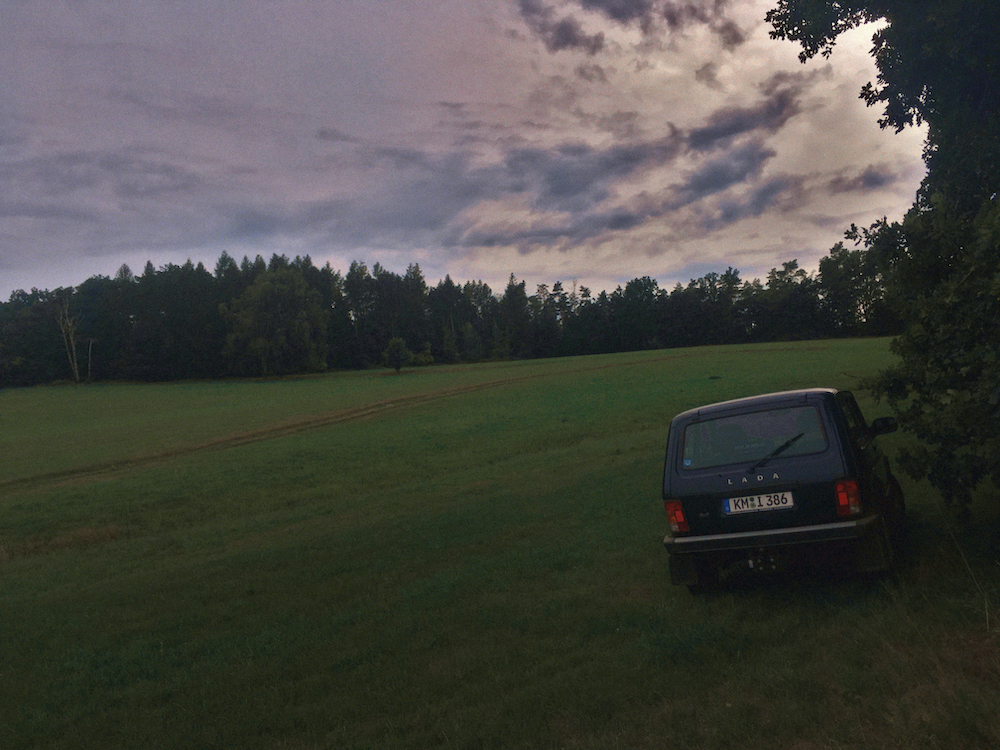
Heard from the hills of Aveyron, southern France. From the farmlands of Lentiourel, there nothing to see, but the sunday morning has now become surrounded by a speed rallye of motorbikes and tuning cars. The voices of the engines roar around us –but the birds and insects in the fields continues their early summer life. Funnily enough, the friends who host the community at the Oasis de Lentiourel, including the microtonal musician Jacques Dudon, call this field la prairie des mille voix, or “the meadow of a thousand voices”.
>> Listen to Rallye à Lentiourel and the Off-Air archive here.
sound library:
from Valparaíso to La Paz
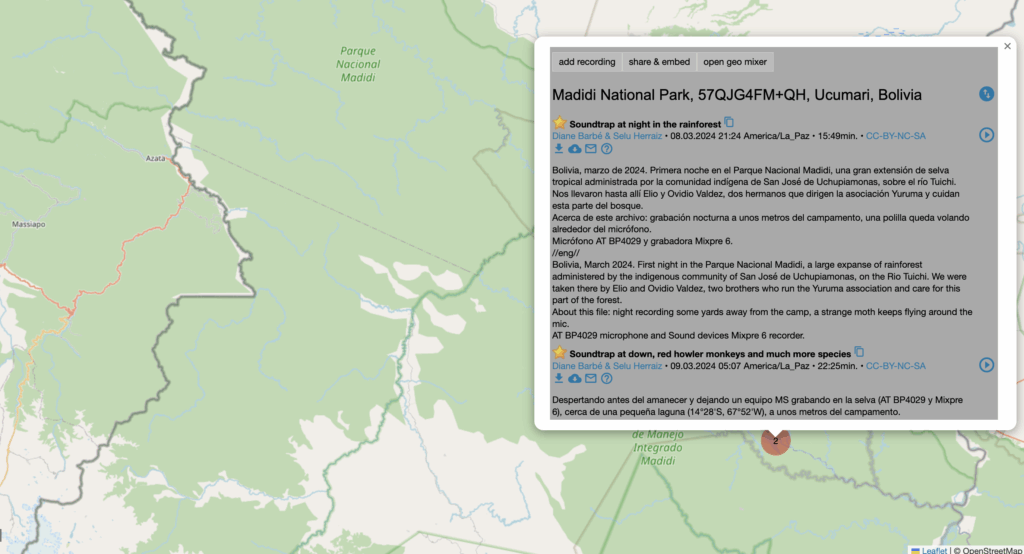
a collection of recordings made by Diane Barbé & Selu Herraiz in 2024, starting in Valparaíso, Chile (hosted by the Tsonami community), continuing in the Atacama desert via Copiapó, Pan de Azúcar, Socaire and San Pedro de Atacama, and moving through Bolivia via Oruro, Obrajes, Cochabamba, La Paz, and Parque Nacional Madidi. Explorations in deserts, highlands, and tropical rainforest.
Most recordings were realised in close collaboration with Selu Herraiz and we do not wish to differentiate individual authorship.
All sounds are licensed CC BY-NC-SA, which means that we are happy if people download them and use them if you give proper credits (BY) only for non-commercial use (NC) and in the same terms (SA, meaning that through your project, others may also then reuse the sounds freely for non-commercial purposes, and so on).
>> Listen to the full archive on Aporee Maps or browse with our user sound library also on Aporee.
tartamudeos en Valparaíso
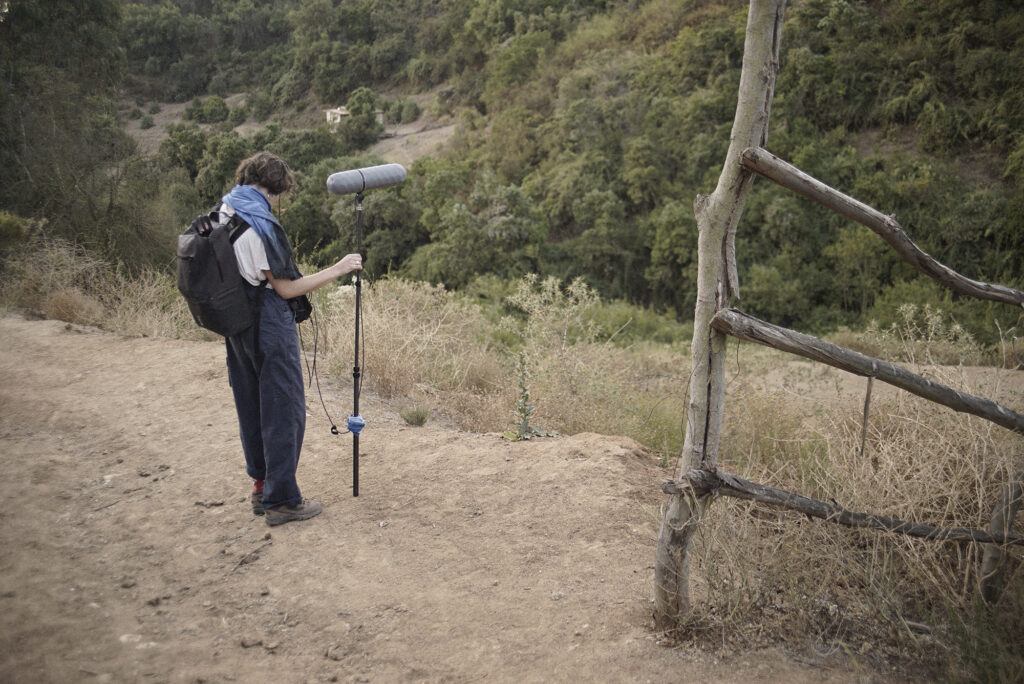
In January 2024, Selu Herraiz and I were invited for a month-long residency at Tsonami, in Valparaíso, Chile. We spent the time there writing, drawing, listening and recording, witnessing political unrest and wildfires; and published a compilation of experiences, ideas, thoughts, moments, sensations, feelings and states of mind during the stay in Valparaiso. Two voices mix in the article, the green and the blue, the ocean and the ravine. An extract:
La lengua con la que aquí nos comunicamos a diario es el castellano: un estándar, que ha sustituido a muchos otros lenguajes, ha sustituido formas de pensar, que unifica y borra diferencias, en nombre de la Nación. Hablo castellano no tan mal, pero muchas veces la gente habla rápido y la semántica desaparece. Pero el lenguaje debería ser maleable.
Por ejemplo, un ensayo de José Pérez de Arce nos recuerda los patrones de colonización de la lengua, el cuerpo, el pensamiento, los individuos y los grupos, y señala que podríamos escribir lenguas con la misma facilidad como las escuchamos, en lugar de seguir las reglas estériles de cualquier Academia heredada de las monarquías europeas:
« Pensamos ke escuchamos lo ke oímos, pero no sólo escuchamos sonidos, sino las ideas ke nos recuerdan esos sonidos, como con la escritura, i escuchamos con el cuerpo, el espacio, los otros yo, con la comunidad y mas allá, con el paisaje. » (Arce, en AURAL Nº5 – Decolonizar la escucha, 2023)
En cambio, escucho el canto de voces, las entonaciones, las quejas, las melodías que suben y bajan por los cerros de la ciudad al menos en la misma medida. Liberar el modo analítico y preciso del lenguaje, para entrar en algo “peludo”, es decir: capaz de establecer muchos pequeños vínculos con todo nuestro entorno.
>> Read our article, Tartamudeos, published on Tsonami Ediciones.
<< Listen to an extract from our final concert at B.A.S.E Tsonami in Valparaíso, Chile, January 2024, broadcast on Nomadic Radio.
el fin de los días
series of videos, each 15-22min, Chile, autoproduction
El fin de los días is a project of deep listening by Diane Barbé and Selu Herraiz.
It focuses on extremely slow movements and long recordings to experience the end of the day, when the sunlight fades out. Depending on our awareness, this moment may feel long or short, fleeting or suspended in time. It is part of a methodology of urban mapping, developed during a residency at Tsonami –Centro de Arte Sonoro in Valparaíso, Chile.
VA – harkening critters (fom12)
forms of minutiae presents ‘harkening critters’, the label’s second non-profit compilation of field recordings and soundscape compositions highlighting, this time, the incredible variety of animal signals.
Stemming from the archaic verb “harken” which means “to listen” or “to give respectful attention to”, indeed, this gathering of contributions from 32 field recordists and sound artists from across the world tunes in to the plethora of vocalizations, mechanical emanations, and any other acoustics phenomenon produced by animals.
Other artists on the compilation include alyssa moxley, andrew pekler, cheryl e. leonard, felicity mangan, félix blume, gina lo, jana irmert, jonáš gruska, joshua bonnetta, juan josé lópez díez, katharina schmidt, kmru, pablo diserens, & more!
>> Discover the full compilation on forms of minutiae’s bandcamp.
réveil livestream
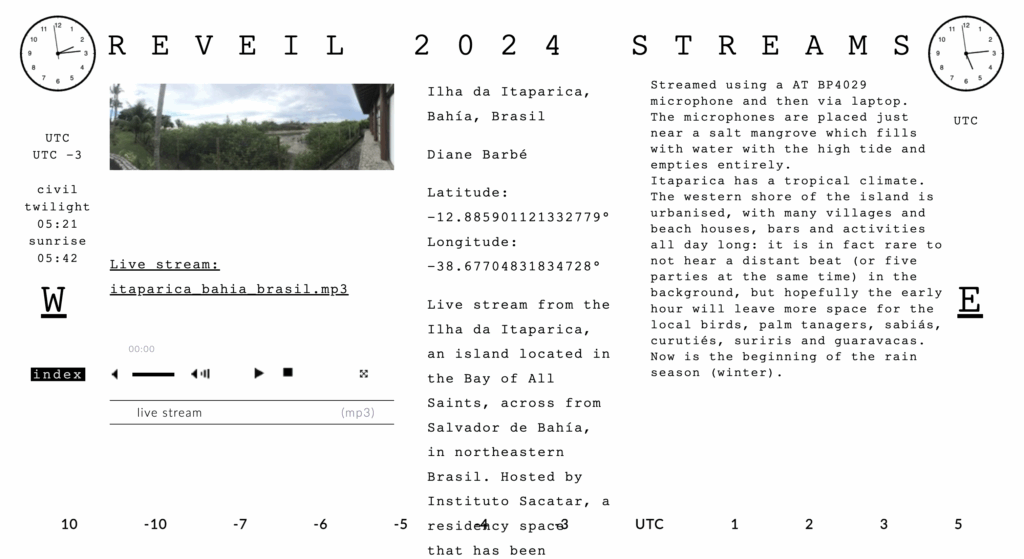
Ilha da Itaparica, Bahía, Brasil
Streamer(s): Diane Barbé
Broadcast time (your location UTC+2):
SAT 10:21 – SAT 10:42
Broadcast time (stream location UTC-3):
SAT 05:21 – SAT 05:42 (Civil Twilight – Sunrise)
Coordinates: -12.88590°, -38.67704°
Streamed using a AT BP4029 microphone and then via laptop.
The microphones are placed just near a salt mangrove which fills with water with the high tide and empties entirely.
Itaparica has a tropical climate. The western shore of the island is urbanised, with many villages and beach houses, bars and activities all day long: it is in fact rare to not hear a distant beat (or five parties at the same time) in the background, but hopefully the early hour will leave more space for the local birds, palm tanagers, sabiás, curutiés, suriris and guaravacas. Now is the beginning of the rain season (winter).